Posts Tagged ‘Extensions’
Posted by the editors on Wednesday, 10 April 2013

Residential Architecture: Cabane 217 by Bourgeois Lechasseur Architectes: “..Cabane 217 is a project to completely redesign a home located in Ste-Catherine-de-la-Jacques-Cartier, Quebec, Canada. The house is located on a wooded lot bordering the river. The owner wanted to give his home new life by opening it up to its surroundings. The changes also involved completely rethinking the living areas in order to create a dialogue between the outside and the inside. The basic premise consisted of preserving some of the building’s original country character and creating a contemporary project that is in harmony with its environment. The design followed a preliminary LEGO™ model created by the owner..The steep slope of the roof was kept, but the traditional dormer windows have been transformed. One dormer opens onto the street to shyly reveal the staircase and to provide light to the home’s central space. On the side nearest the river, part of the roof has been raised to accommodate the master bedroom and ensuite bathroom. This second, much larger, dormer creates an airy, bright space. The client was thus able to keep the idea of a “tree house” and still preserve privacy with the surrounding vegetation..The screen room that stands out from the main part of the building is an addition to the original house. This room has a fireplace and is both intimate and welcoming. This contrast with the spacious rooms and the large deck leads the client into a new relationship with his environment. It provides a threshold between the inside and the outside and frames the view of the site..The inside is now much brighter with nature all around. The kitchen has been completely renovated. The wood panels and the slate floor respect the natural, warm feel of the place. A new lighter, brighter staircase leads to the upper floor. The bathroom, with its spectacular shower, opens on the master bedroom. The floor-to-ceiling windows in the bedroom give the impression of floating in the trees..The materials used on the outside integrate well into the region’s natural and built environment. The original wood siding was kept and repainted. The windows are wood like the original ones and seem to flow into the marine plywood panels that extend and define the new elements. The metal roof reflects the sun and calls to mind the traditionally inspired design of this country home..” Extensive glazing, natural light, nature views; impressive renovation, with extension, of traditional small home..
designalog : contact
image: © Stéphane Groleau; article: “Cabane 217 / Bourgeois Lechasseur Architectes” 05 Apr 2013. ArchDaily
Posted in Architects, Architecture, Architecture + Design, Contemporary Architecture, contemporary design, Design, Design & Decoration, Designalog, Interior Decoration, Interior Design, Interiors, Residential Architecture | Tagged: Additions, archdaily, Architecture, Bourgeois Lechasseur Architectes, Cabane 217, Cabane 217 by Bourgeois Lechasseur Architectes, Canada, Decks, Design, Designalog, Extensions, glass, Lego, Marine Plywood Panels, North America, Quebec, Remodeling, Renovations, Slate Flooring, wood | Leave a Comment »
Posted by the editors on Tuesday, 5 March 2013

Residential Architecture: Hawthbush Extension by Mole Architects: “..UK firm Mole Architects extended a protected farmhouse in south-east England by adding an extension with a barrel-vaulted roof that references local agricultural buildings..Located in the High Weald area of the Sussex Downs, the Hawthbush extension replaced several earlier additions constructed in the 1970s..The new structure was placed at an angle to the existing house and visually separated from it by a glass link to replicate the layout of traditional local farmsteads, according to recent research carried out using historical maps of the area..Associating the design with this research allowed them to gain planning permission where previous proposals had failed. This apparent separation also helps to reduce the scale of the additional volume, giving prominence to the original house..When briefing Mole Architects, one of their clients presented the designers with a pot instead of a room schedule, underlining their wish to gain “a beautifully finished object carefully made from ‘natural’ materials”..A coated steel roof arches over courses of bricks reclaimed from a nearby farmhouse, reinterpreting the barrelled structural language of local agricultural buildings..The concave ceiling that results from the unusually shaped roof is emphasised by internal horizontal cladding, directing attention towards a semi-circular window at the end of the master bedroom on the first floor..Whilst the bedroom’s picture window frames the sunrise, the kitchen on the ground floor benefits from the skewed angle of the extension, which orientates the kitchen on the ground floor towards the south so it’s flooded with sunlight during the day. The kitchen can be opened up to the garden with timber-framed glass doors that concertina out onto the patio..This ongoing project also includes spatial reorganisation of the interior of the old farmhouse as well as a sustainable development strategy that affects a broader collection of buildings in the farmyard..Hawthbush farmhouse extension was shortlisted for AJ Small Projects award 2013, which was won by Laura Dewe Mathews for her Gingerbread House. The Forest Pond House folly by TDO was also nominated for this award..Other projects by Mole Architects include a refurbishment of a 1960s bungalow in Cambridgeshire and a house set within the Suffolk dunes designed in collabouration with Jarmund/Vigsnæs Architects..”
See our post on another home by Mole Architects: Residential Architecture: The Lanes by Mole Architects.
image: copyright David Butler; article: Dezeen
designalog : contact
Posted in Architects, Architecture, Architecture + Design, Awards, Contemporary Architecture, contemporary design, Design, Design & Decoration, Designalog, Interior Decoration, Interior Design, Interiors, Residential Architecture | Tagged: Additions, archdaily, Arches, Architecture, Awards, Brick, Cambridge, Cambridgeshire, Coated Steel, Design, Designalog, Extensions, Fenestration, glass, Glass Doors, Hawthbush Extension, Hawthbush Extension by Mole Architects, Homes, Horizontal Cladding, Houses, Housing, Laura Dewe Mathews, Masonry, Mole Architects, Patios, Reclaimed Brick, Remodeling, Renovations, Residential Architecture, Semi-circular Windows, steel, Sussex, The Lanes by Mole Architects, UK, Vernacular Architecture, wood, Wood Cladding | Leave a Comment »
Posted by the editors on Monday, 4 March 2013

Residential Architecture: Garden Tree House by Hironaka Ogawa & Associates: “..This is an extension project on a thirty-five year-old house for a daughter and her husband..A zelkova tree and a Camphor tree stood on the site since the time the main house was built thirty-five years ago. Removing these trees was one of the design requirements because the new additional building could not be built if these trees remained. When I received the offer for the project, I thought of various designs before I visited the site for the first time. However, all my thoughts were blown away as soon as I saw the site in person..The two trees stood there quite strongly. I listen to the stories in detail; the daughter has memories of climbing these trees when she was little..These trees looked over the family for thirty-five years. They colored the garden and grew up with the family. Therefore, utilizing these trees and creating a new place for the client became the main theme for the design..In detail, I cut the two trees with their branches intact. Then I reduced the water content by smoking and drying them for two weeks. Thereafter, I placed the trees where they used to stand and used them as main structural columns in the center of the living room, dining room, and kitchen..In order to mimic the way the trees used to stand, I sunk the building addition 70 centimeters down in the ground. I kept the height of the addition lower than the main house while still maintaining 4 meter (ndlr: 13.12 ft) ceiling height..By the way, the smoking and drying process was done at a kiln within Kagawa prefecture. These two trees returned to the site without ever leaving the prefecture..The client asked a Shinto priest at the nearby shrine to remove evil when the trees were cut. Nobody would go that far without a love and attachment to these trees..When this house is demolished and another new building constructed by a descendant of the client hundreds of years from now, surely these two trees will be reused in some kind of form..” Ample glazing, natural light; interesting materiality, interior volumes, and, especially, a wonderful sense of poetry and connection…
designalog : contact
image: © Daici Ano; article: “Garden Tree House / Hironaka Ogawa & Associates” 27 Feb 2013. ArchDaily
Posted in Architects, Architecture, Architecture + Design, Art, Contemporary Architecture, contemporary design, Design, Design & Decoration, Designalog, Interiors, Residential Architecture | Tagged: Additions, archdaily, Architecture, Asia, Concrete, Design, Designalog, Extensions, Garden Tree House, Garden Tree House by Hironaka Ogawa & Associates, glass, Hironaka Ogawa & Associates, Homes, Houses, Housing, Japan, Kagawa, Mezzanines, Poetry, Remodeling, Residential Architecture, Shinto, Timber, Trees, Wikipedia, wood | Leave a Comment »
Posted by the editors on Thursday, 21 February 2013

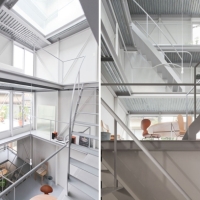
Residential Architecture: North Fitzroy House by AM Architecture: “..The owners approached us with a common question. Is it feasible to extend a semi-detached dwelling on a narrow site? The benefit this property had over comparable detached dwellings was the opportunity to build two levels directly on the party wall. This opened up an array of spatial possibilities allowing a ground floor extension of a new kitchen, dining, meals and living, and on the first floor, a master bed, workstation and en-suite..The response to the heritage overlay was one of complimentary difference. We searched for forms and materials that would create a relationship with the existing building but ultimately end up in a contemporary expression that would make no apology for being new. The resultant form is a black, single pitched volume that extrudes along the site reflecting same angle as the existing tiled roof, and switching dramatically in direction at the rear, responding to adjoining neighbours sun access and opening up to a north facing rear garden..The materials and new colours from the existing heritage portico are used internally and externally in the new addition. These common materials serve to bind the two parts together, reinforcing the idea that both old and new, so different in era and style, are borne of the same substance. An important part of the owners brief was a separate dining area screened from the kitchen that would still maintain a spatial connection. This is the first space entered when leaving the old building. It is intended as a night time space, being the deepest into the site and is surrounded by a tactile combination of materials including white bagged brickwork referencing the face brickwork at the front of the building, white painted timber cladding connecting to the painted timber soffit of the portico, glossy white steel plate, exposed polished concrete, charcoal timber shiplap cladding and a timber veneer drinks cabinet. During the day, skylights and long windows wash perpendicular walls, so the space receives a reflected and ambient glow of light..At the core of the extension is the kitchen with void above, which connects a first floor master bedroom and en-suite in a lofty mezzanine. The kitchen is a timber insertion into a white space, and includes a solid timber island bench that doubles as a meals table connecting directly to the living area. A double height wall alongside the stair has large windows placed at the north end to flood it with clear and coloured light, and a long window running the entire western side, creates ever-changing patterns of direct and reflected light throughout the afternoon and evening. The living area is fully glazed to the northern garden and the first floor the en-suite above sits in a deep white recess for privacy, enjoying a high pitching ceiling that opens the space up to the sky and nearby trees ..The design was the product of a fluid working relationship between the clients and architect with the clients embracing new ideas with enthusiasm. Good communication between everyone led to a pleasurable design process and a building that emerged on the other side with its integrity intact. The extension that eventuated from what was a narrow site feels spatially generous and tactile materials combined with ever-changing qualities of light have created a series of interconnected spaces that are a pleasure to spend time in..” Extensive glazing, natural light; interesting form, interior volumes, fenestration and materiality..
designalog : contact
image: © Dianna Snape; article: “North Fitzroy House / AM Architecture” 18 Feb 2013. ArchDaily
Posted in Architects, Architecture, Architecture + Design, Contemporary Architecture, contemporary design, Design, Designalog, Interiors, Residential Architecture | Tagged: Additions, AM Architecture, archdaily, Architecture, Australia, Brick, Dark Cladding, Design, Designalog, Double-Height Spaces, Extensions, Fenestration, Masonry, Melbourne, Narrow Sites, North Fitzroy House, North Fitzroy House by AM Architecture, Polished Concrete, Remodeling, Renovations, Skylights, steel, Timber, Timber Cladding, wood, Wood Cladding | Leave a Comment »




 Designalog