Posts Tagged ‘Melbourne’
Posted by the editors on Wednesday, 27 March 2013
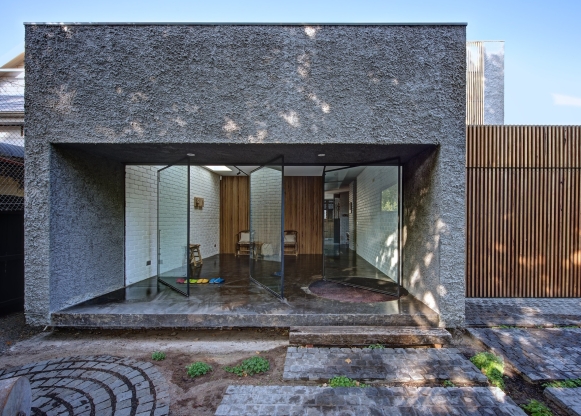
Residential Architecture: The New Old House by Jessica Liew: “..A house that maximizes a relatively small 385m² site in inner city Melbourne, Australia, providing bright but private living spaces. There is simple, relaxed feel about this house, loaded with character from the natural materials used including concrete, recycled tumbled bricks and hardwood timber. These provide an honesty and rawness so rarely seen these days – an antithesis to the glitz, luxe and glamour often seen in popular magazine and tv programs. To the architect/owner, the aim was to build a relaxed, private home that was energy efficient, practical and imbued with character from the all-natural materials used – complementing their extensive collection of art and antiquities from their travels. The result is remarkable. A home that has outwitted even other architects who have mistaken it for a renovation, rather than a newly-built dwelling on what was previously the neighbors tennis court..Accommodation: double storey dwelling comprising formal living, library, cellar, study, casual living and dining, separate laundry, rumpus, 3 bedrooms, 3 bathrooms and 3 car accommodation..6 star energy rated: double glazed windows and skylights, double hung ceilings, double insulated stud walls,reverse brick veneer walls, underground water tank, hydronic slab heating, recycled bricks, custom double height pile wool carpet, regenerative hardwood timbers throughout..‘Switchable’ spaces including a study turning into a guest bedroom (murphy bed); rumpus or second study on level 1; and studio or 3rd bedroom upstairs..A courtyard sized to a car space for future additional parking requirement. Hidden storage and joinery throughout. Custom steel framed glass pivot doors replacing a conventional front door, the recessed floor mat is the only give away..Antique Chinese screen doors framing the fishpond corridor , mural by celebrated Melbourne street artists Ghostpatrol and Miso; retention of the original chain wire mesh tennis court fencing and tennis court roller; all rooms feature a garden, fishpond or courtyard aspect..Honesty: respect and transparency for all natural materials used – predominant palette comprising black concrete, white painted tumbled bricks and natural timber finish waiting to age with the house..” Extensive glazing, natural light, privacy; interesting interior volumes and materiality..
designalog : contact
image: © Jaime Diaz-Berrio; article: “The New Old / Jessica Liew” 20 Mar 2013. ArchDaily
Posted in Architects, Architecture, Architecture + Design, Contemporary Architecture, contemporary design, Design & Decoration, Designalog, Green Design, Interior Decoration, Interior Design, Interiors, Residential Architecture, Sustainable Architecture | Tagged: archdaily, Architecture, Australia, Black Concrete, Brick, Concrete, Design, Designalog, glass, Hardwood, Homes, Houses, Housing, Jessica Liew, Lightwells, Melbourne, Pivoting Doors, Recycled Bricks, Residential Architecture, Skylights, sustainability, The New Old House, The New Old House by Jessica Liew, Tumbled Bricks, White Painted Bricks, wood | Leave a Comment »
Posted by the editors on Wednesday, 13 March 2013

Residential Architecture: TreeHouse by FMD Architects: “..The site is a residential block in Lorne, Victoria, Australia. Several large eucalypt trees are clustered in the southeastern end of the block, offering a treed streetscape context to the site. The house was to contain individual zones for the couple and their 2 adult daughters, with the opportunity to separate access between the spaces. A large Living and Dining space with outdoor entertaining areas were required, within which all family members and friends could congregate. Another important brief requirement was a space in which the client could practice yoga, offering spatial isolation with an external outlook..The trees were to be retained as far as possible and their relationship with the building emphasised internally and externally. Views to the ocean were to be considered on equal terms with the views to and through the trees. The trees and associated root zones were also carefully analysed to ensure their health was not impacted by the new structure and setback accordingly..Planning constraints were stretched to their limit, maximising the site coverage of 35% and the setbacks particular to the area. Views from neighbouring properties were also an important consideration, with the building keeping a low profile at the rear of site to ensure it did not impact on its rear neighbours.As well as working around the trees, the multiple zones and the need for spaces, which allowed both isolation and congregation, were also major considerations..A particular client requirement was to allow internal and external spaces, within which yoga could be practiced. These spaces were to allow for physical isolation with an external outlook, allowing one to look within while understanding one’s position within the external context..The planning of the house aims to demonstrate that each participant perceives a different physical centre. As each user isolates themselves or interacts with another, the perception of their built environment and use thereof is adjusted, thus creating a continually shifting physical centre. This in turn relates to the process of yoga striving to achieve inner balance through movement and stillness. Multiple private outdoor spaces are an example of this, as is the asymmetrical planning on the site in deference to the trees. The curved path from the main living to the main bedroom offers another example, as the external and internal walls between these spaces stretch themselves in 3 dimensions. Each joinery element between these spaces reinforces the tensed relationship through their form. In many ways the design aims to outline the importance of the process rather than achieving balance itself..” Ample glazing, natural light, views; contextuality; indoor / outdoor sensibility..
See our post on another home by FMD Architects: Residential Architecture: South Eastern Residence by FMD Architects.
designalog : contact
image: © Shannon MacGrath; article: “TreeHouse / FMD Architects” 08 Mar 2013. ArchDaily
Posted in Architects, Architecture, Architecture + Design, Contemporary Architecture, contemporary design, Design, Designalog, Interiors, Residential Architecture | Tagged: archdaily, Architecture, Australia, Balconies, Dark Vertical Cladding, Design, Designalog, FMD Architects, glass, Homes, Houses, Housing, Indoor/Outdoor, Melbourne, Metal Cladding, Residential Architecture, South Eastern Residence by FMD Architects, Steep Sites, Terraces, TreeHouse, TreeHouse by FMD Architects, Vertical Cladding, Victoria, Yoga | Leave a Comment »
Posted by the editors on Thursday, 21 February 2013

Residential Architecture: North Fitzroy House by AM Architecture: “..The owners approached us with a common question. Is it feasible to extend a semi-detached dwelling on a narrow site? The benefit this property had over comparable detached dwellings was the opportunity to build two levels directly on the party wall. This opened up an array of spatial possibilities allowing a ground floor extension of a new kitchen, dining, meals and living, and on the first floor, a master bed, workstation and en-suite..The response to the heritage overlay was one of complimentary difference. We searched for forms and materials that would create a relationship with the existing building but ultimately end up in a contemporary expression that would make no apology for being new. The resultant form is a black, single pitched volume that extrudes along the site reflecting same angle as the existing tiled roof, and switching dramatically in direction at the rear, responding to adjoining neighbours sun access and opening up to a north facing rear garden..The materials and new colours from the existing heritage portico are used internally and externally in the new addition. These common materials serve to bind the two parts together, reinforcing the idea that both old and new, so different in era and style, are borne of the same substance. An important part of the owners brief was a separate dining area screened from the kitchen that would still maintain a spatial connection. This is the first space entered when leaving the old building. It is intended as a night time space, being the deepest into the site and is surrounded by a tactile combination of materials including white bagged brickwork referencing the face brickwork at the front of the building, white painted timber cladding connecting to the painted timber soffit of the portico, glossy white steel plate, exposed polished concrete, charcoal timber shiplap cladding and a timber veneer drinks cabinet. During the day, skylights and long windows wash perpendicular walls, so the space receives a reflected and ambient glow of light..At the core of the extension is the kitchen with void above, which connects a first floor master bedroom and en-suite in a lofty mezzanine. The kitchen is a timber insertion into a white space, and includes a solid timber island bench that doubles as a meals table connecting directly to the living area. A double height wall alongside the stair has large windows placed at the north end to flood it with clear and coloured light, and a long window running the entire western side, creates ever-changing patterns of direct and reflected light throughout the afternoon and evening. The living area is fully glazed to the northern garden and the first floor the en-suite above sits in a deep white recess for privacy, enjoying a high pitching ceiling that opens the space up to the sky and nearby trees ..The design was the product of a fluid working relationship between the clients and architect with the clients embracing new ideas with enthusiasm. Good communication between everyone led to a pleasurable design process and a building that emerged on the other side with its integrity intact. The extension that eventuated from what was a narrow site feels spatially generous and tactile materials combined with ever-changing qualities of light have created a series of interconnected spaces that are a pleasure to spend time in..” Extensive glazing, natural light; interesting form, interior volumes, fenestration and materiality..
designalog : contact
image: © Dianna Snape; article: “North Fitzroy House / AM Architecture” 18 Feb 2013. ArchDaily
Posted in Architects, Architecture, Architecture + Design, Contemporary Architecture, contemporary design, Design, Designalog, Interiors, Residential Architecture | Tagged: Additions, AM Architecture, archdaily, Architecture, Australia, Brick, Dark Cladding, Design, Designalog, Double-Height Spaces, Extensions, Fenestration, Masonry, Melbourne, Narrow Sites, North Fitzroy House, North Fitzroy House by AM Architecture, Polished Concrete, Remodeling, Renovations, Skylights, steel, Timber, Timber Cladding, wood, Wood Cladding | Leave a Comment »
Posted by the editors on Wednesday, 30 January 2013

Residential Architecture: Enclave House by BKK Architects: “..This project has been undertaken for a couple and their children of varying ages. (In Melbourne, Autralia), it includes alterations to an existing Edwardian House and a new separate studio to the rear of the site..The house is designed so that the spaces within and around the house will be adaptable over time to suit the changing needs of the family. The possibility for the studio space to be converted into an office has been considered as has the basement entertainment area conversion into a gym or multi-purpose play room. A central courtyard contains a pool and landscaped areas..The environmental initiatives for the project can be summarized as follows; •There is a 25,000lt underground rain water harvesting tank. •Double glazed windows throughout. •Highly insulated walls floors and roof. •Locally resourced, sustainable, plantation timber cladding. •Materials that are low-maintenance with inherent finishes. •Low-VOC materials. •Highly water efficient fixtures and fittings. •The existing residence has been retained and restored. •The planning and construction is designed to be highly adaptable..Formally, the extension at the rear of the existing residence is conceived through a subtractive approach that appears to have been carved from a solid block, chiseled away to cater to the planning/heritage overlays, whilst also drawing light back into the residence..Deep reveals form the windows to the upper floor to protect the gaze from the surrounding residences. An interior lightwell and water feature extend the garden space to the centre of the living spaces. The garden has also been carefully crafted to create its own secret garden, complete with designer cubby house. There is an overwhelming sense of seclusion in both the house and garden that creates a type of space that is the family’s own, a retreat from busy lives and the surrounding chaos..The fabric of the building/s operates like a protective cocoon. The differing materiality of the two levels of the extensions creates the impression that the house has been capped or that a ‘helmet’ is placed upon the exterior walls..” Ample glazing, natural light; interesting form, materiality, interior volumes; sustainability..
See our post on another home by BKK Architects: Residential Architecture: Beached House by BKK Architects.
designalog : contact
image: © John Wheatley – UA Creative; article: “Enclave House / BKK Architects” 28 Jan 2013. ArchDaily.>
Posted in Architects, Architecture, Architecture + Design, Contemporary Architecture, contemporary design, Design, Design & Decoration, Designalog, Interiors, Residential Architecture, Sustainable Architecture, Sustainable Design | Tagged: Additions, archdaily, Architecture, Autralia, Beached House by BKK Architects, BKK Architects, Brick, Design, Designalog, Enclave House, Enclave House by BKK Architects, Extensions, Gardens, Homes, Houses, Housing, Lightwells, Low VOC, Melbourne, Metal, Rainwater Collection, Remodeling, Renovations, Residential Architecture, Stone, Studios, sustainability, Swimming Pools, Timber Cladding, wood, Wood Cladding | Leave a Comment »


 Designalog